New Spectral Workflows in ClimateStudio
Solemma is happy to announce two new ClimateStudio workflows: Spectral Radiance Render and Spectral Point-in-time Illuminance, developed in collaboration with the U.S. Department of Energy Solid-State Lighting Program.
The new spectral workflows help architects and lighting designers predict the non-visual effects of light in order to promote the design of healthy, productive environments. Outputs include equivalent melanopic lux (EML), melanopic-to-photopic ratio (M/P), and irradiance spectra arriving at the eye. Users can upload custom luminaire spectral power distributions (SPDs) or choose from a library of measured lamp spectra provided by Pacific National Northwest Laboratory (PNNL). Spectral sky models have also been included, based on the validated radiative transfer library libRadtran. Lastly, hundreds of spectrophotometrically-measured glazing systems and material finishes have been added, to ensure that material behavior can be realistically modeled.
Why Spectral?
The human eye is not just for seeing. It also contains special photoreceptors (called intrinsically photosensitive retinal ganglion cells, or ipRGCs) that help regulate alertness, sleep, and circadian rhythms. Because these receptors have color responses that differ from those of cone cells, their stimulus cannot be modeled using traditional RGB color rendering. To overcome this limitation, ClimateStudio’s spectral workflows carry out simulations in 20 color channels using Radiance -- a lighting engine developed by Lawrence Berkeley National Laboratory.
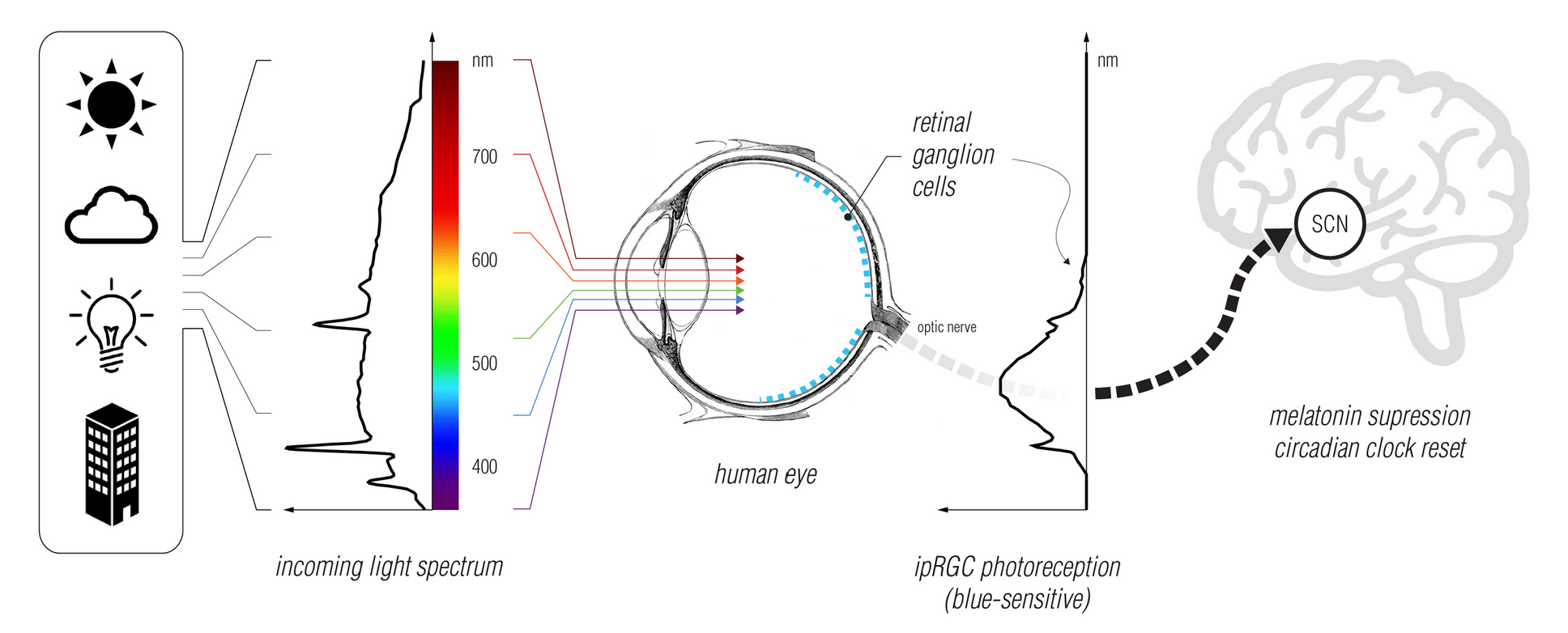
Visualization of the biological processes behind spectral stimulus.
Workflow #1: Spectral Point-in-Time Illuminance
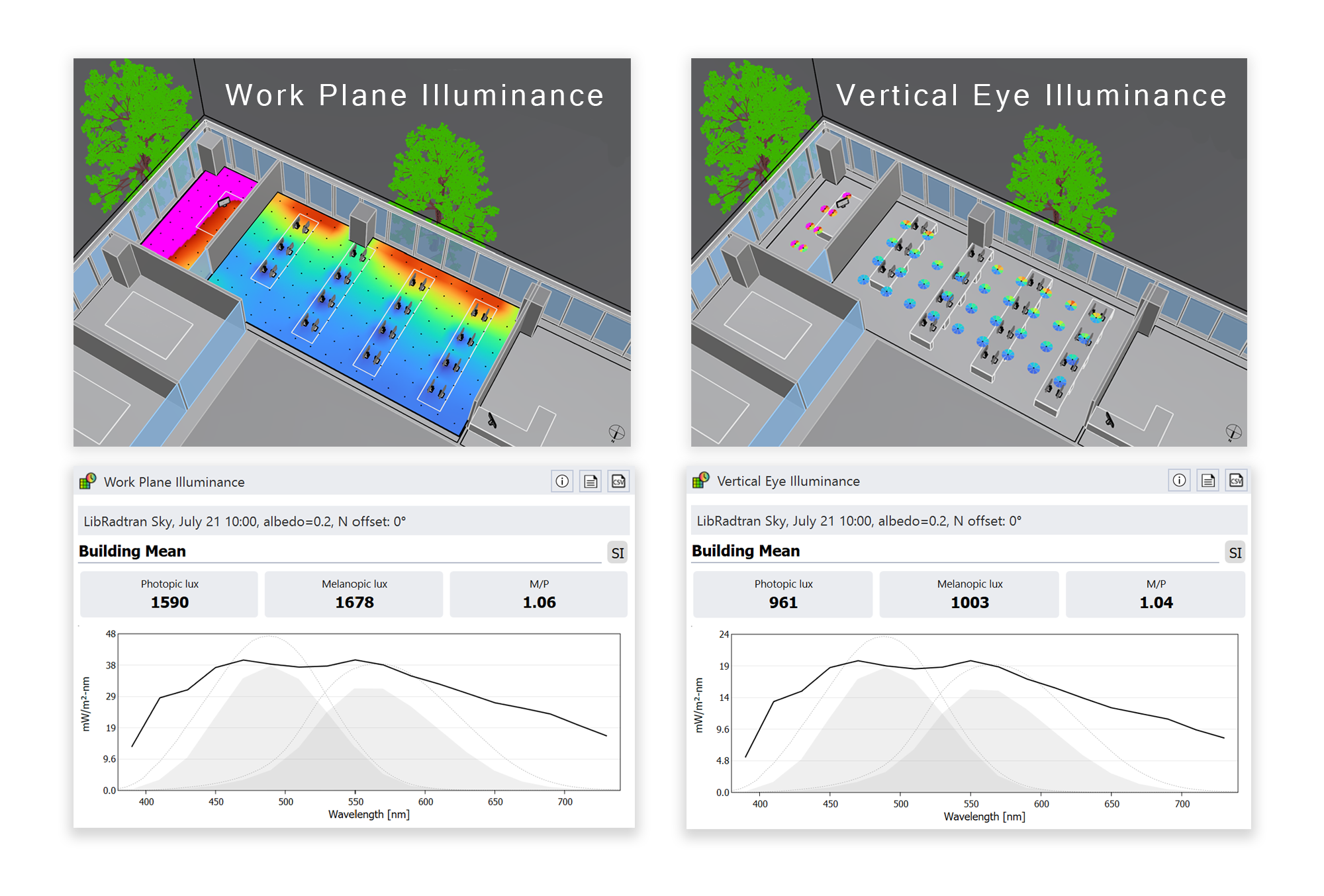
The Spectral Point-in-Time Illuminance workflow supports the calculation of illuminance distributions for electric lighting and/or daylight at specific moments in time. Outputs of the simulation include photopic lux, melanopic lux, and M/P ratio. The term melanopic derives from melanopsin, the pigment found in ipRG cells that drives the non-visual response. Higher melanopic lux values indicate illuminance with a greater capacity to produce melatonin-suppressing, alerting effects.
The workflow offers two analysis modes:
Work Plane Illuminance – for measuring light falling on a plane (e.g. a horizontal plane at desk height).
Vertical Eye Illuminance – for measuring light arriving at the eye. In this option, sensors are positioned at seated eye height and oriented in one or more viewing directions, which are drawn as "slices" in the viewport.
The first mode is useful for assessing color rendition on the task plane, while the second is useful for assessing the alerting potential of light arriving at the eye. The new circadian metrics give designers insight into the non-visual impact of their lighting concepts, and aid in the selection of lamp spectra and material finishes that are appropriate for alerting or calming programmatic intents.
Workflow #2: Spectral Radiance Rendering
The Spectral Radiance Rendering workflow supports the creation of physically-based, hyperspectral Radiance (HSR) pictures. When deployed with fisheye lenses, Spectral Radiance Renderings can be used to capture equivalent melanopic lux (EML) arriving at the camera. Unlike the illuminance workflow, the rendered images also contain angular information, describing where in the visual field different components of the integrated color spectrum come from. This information can help designers understand the role of both direct illumination and material finish selection in shaping occupant experience. Using the render workflow’s post-processing option for lighting zones, luminaire spectra can even be adjusted in real time after a rendering has finished.
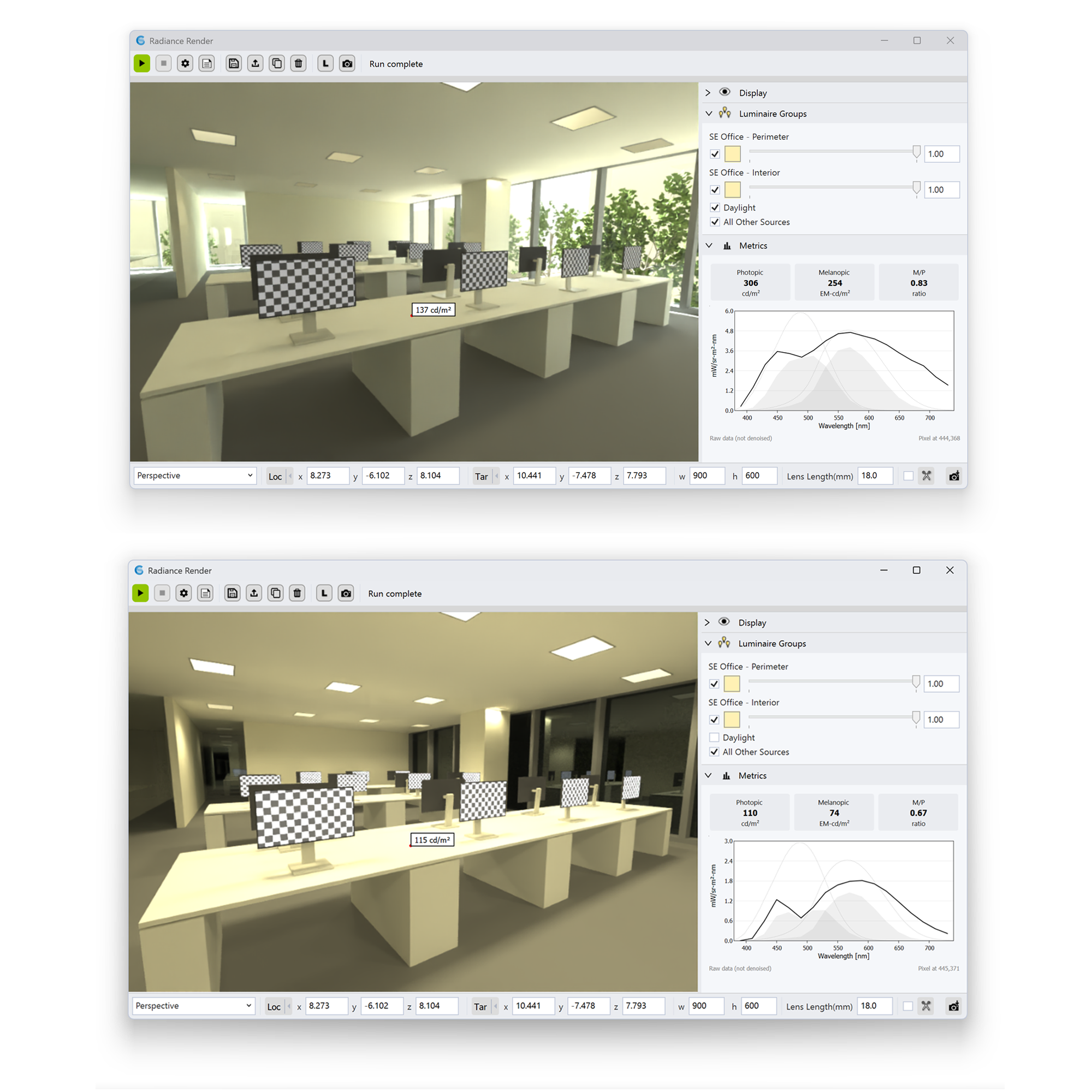
Snapshots of the Spectral Radiance Render window in ClimateStudio 2.3. The top image visualizes a corner office with two lighting groups and daylight turned on. The bottom image visualizes the same office with daylight turned off.
Spectral Luminaires
In interior settings, the melanopic lux arriving at the eye is highly dependent on the wavelengths emitted by luminaires. ClimateStudio comes with a library of high-resolution source spectra taken from measurements of real luminaires – making it easy to test the non-visual impact of specific lighting technologies. You can also upload custom luminaire source spectra via CSV file.
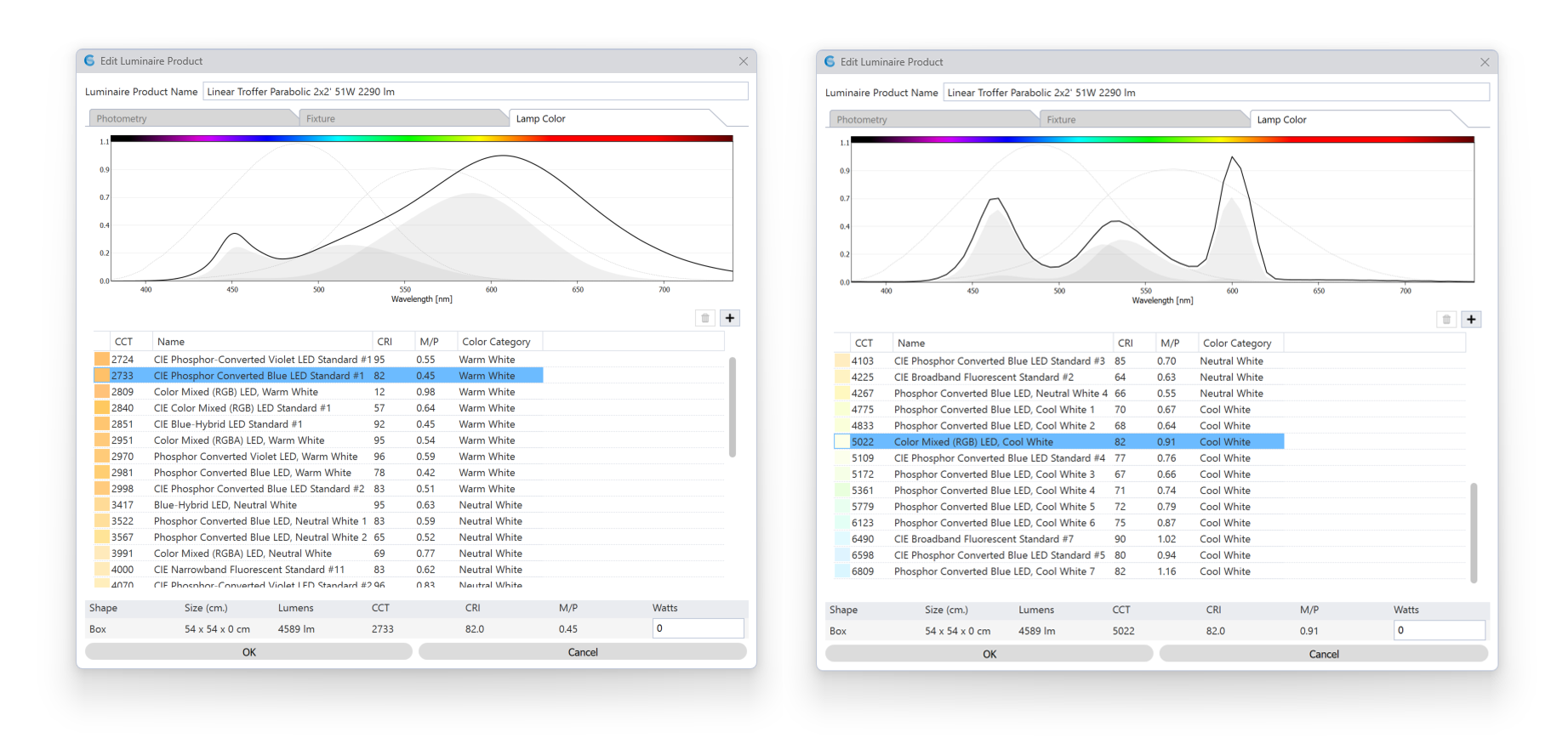
Snapshots of the luminaire browser and editor in ClimateStudio 2.3.
Spectral Skies
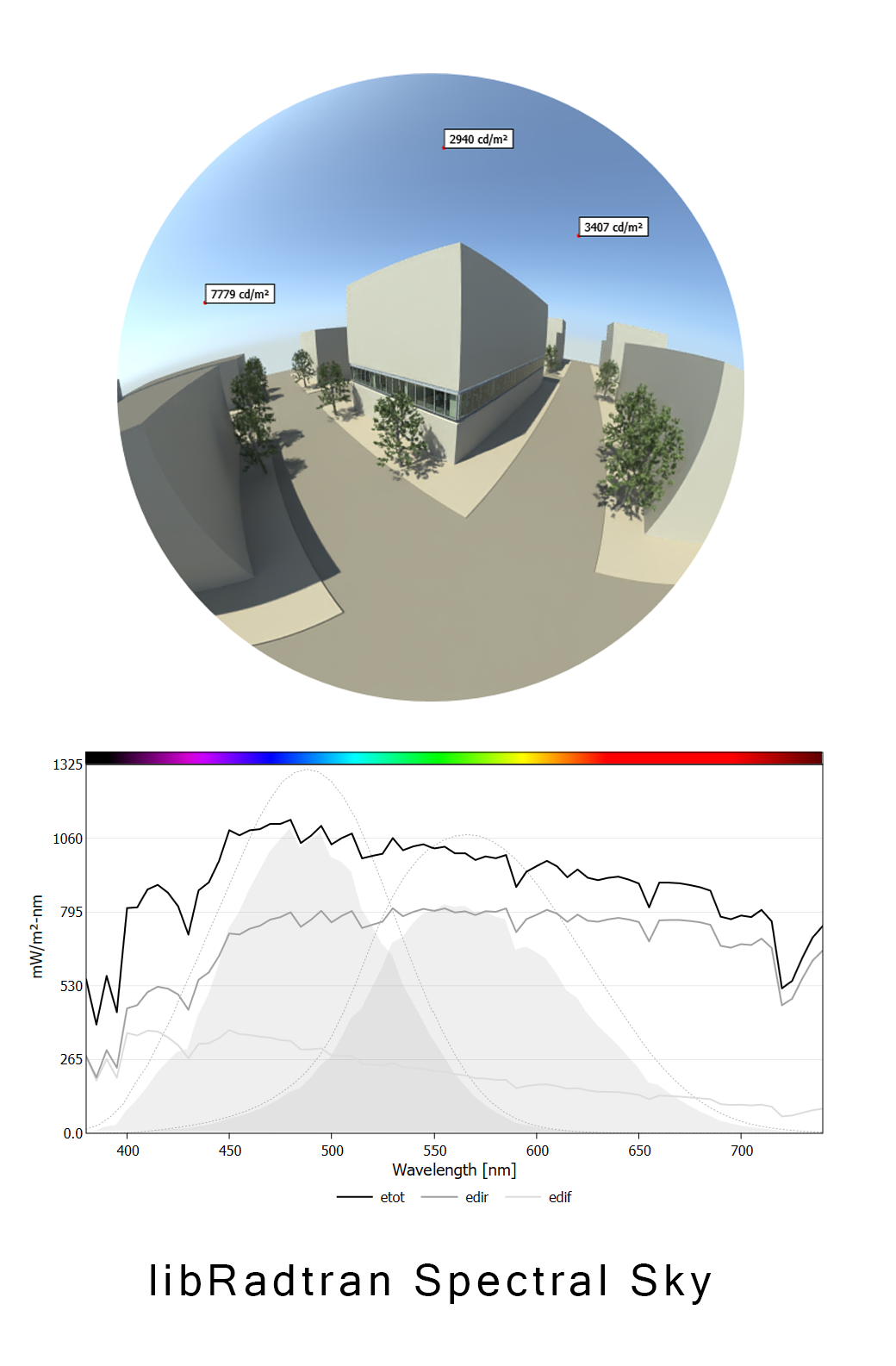
The daytime sky is a powerful driver of circadian biology. Unlike (most) man-made light sources, it varies in color not only by time of day, but also by direction of view. To simulate it accurately, ClimateStudio deploys spectral calculations using the best-in-class radiative transfer library, libRadtran. This lets ClimateStudio users pull up physically-accurate clear, hazy, or overcast skies for any location on Earth.
Spectral Materials
Between emission from a source and arrival at the eye, light spectra are modified by transmission and reflection off material surfaces. To ensure realistic results, ClimateStudio’s material library has been updated to include spectral characterizations of all opaque materials and glazing units, expanding the materials library.
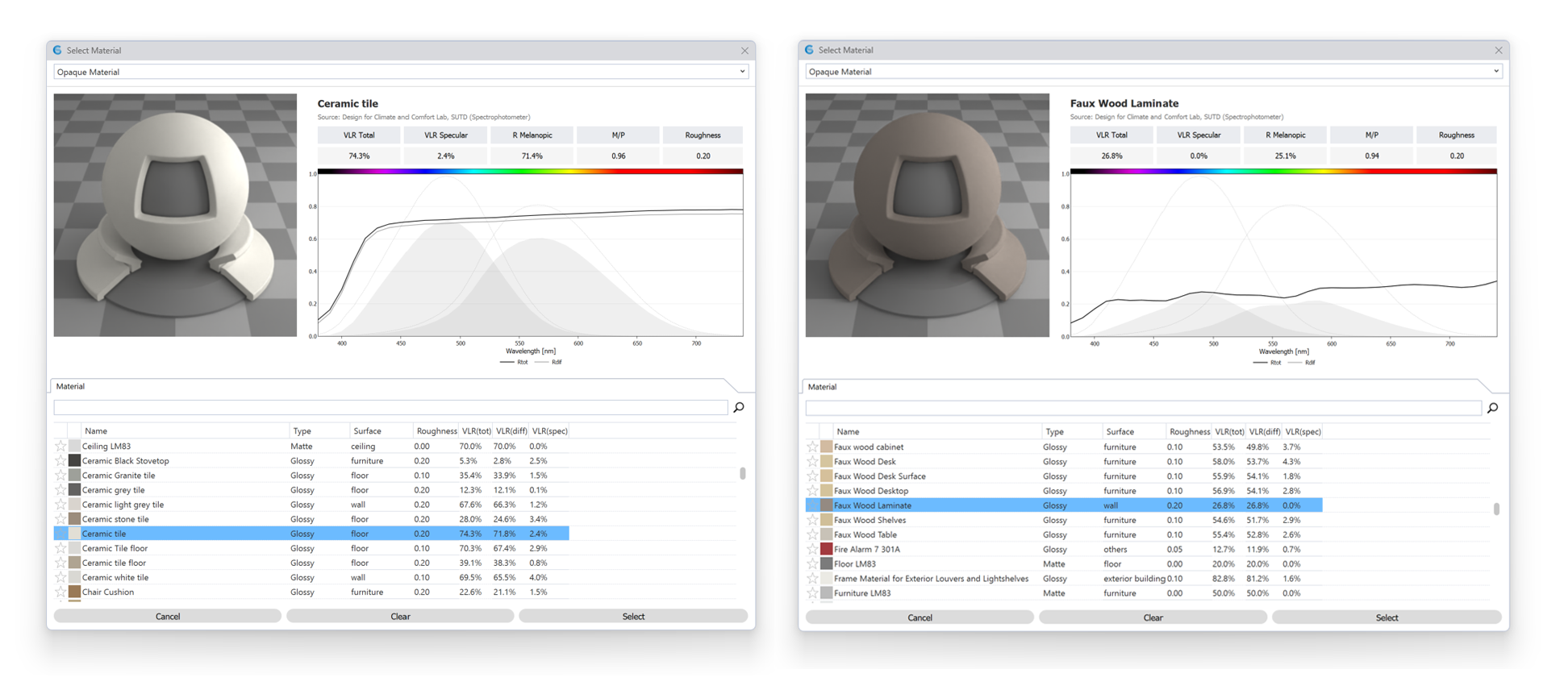
Snapshots of the material browser and editor in ClimateStudio 2.3.
To download the latest service release and access the new spectral workflows, run the command CSVersion inside Rhino or download the installer here. For more information on our licensing options, submit a trial and pricing information request or contact us at sales@solemma.com.